
Introduction
Sourcing high quality Wooden pallets from Pakistan has become a strategic priority for global logistics managers in 2026. As North American and European timber markets face rising tariffs and shortages, Pakistan has emerged as a reliable hub for cost-effective, ISPM-15 certified industrial packaging. Whether you need standard Euro pallets or custom hardwood skids, understanding the local export landscape is crucial to securing the best deal.
In this high-pressure environment, Pakistan has quietly emerged as a strategic sourcing hub for industrial wooden packaging. With a maturing timber sector capable of producing ISPM-15 certified, high-load-bearing pallets at a fraction of European or North American production costs, Pakistan is no longer just a “cheap option”—it is a competitive necessity.
But sourcing pallets internationally is not without risk. Mold, dimensional variance, and non-compliance can shut down your supply chain instantly. This guide outlines how to leverage Pakistan’s wood packaging sector in 2026 without compromising on quality or speed.
The 2026 Pallet Market: Why Look to Pakistan?
The global wooden pallet market is projected to cross $15.28 billion this year. Here is why buyers are shifting their gaze to South Asia:
Tariff Avoidance: With new 2026 tariff hikes on softwood lumber imports affecting major Western markets, sourcing finished packaging from tariff-friendly zones like Pakistan offers immediate margin relief.
The “Automation” Factor: Modern warehouses (Amazon, DHL, Maersk) utilize Automated Storage and Retrieval Systems (AS/RS). These robots break down if a pallet is even 5mm off-spec. Leading Pakistani manufacturers have upgraded to automated nailing lines to meet these zero-tolerance standards.
Sustainable Hardwood Options: Unlike the pure softwood markets of Europe, Pakistan offers Eucalyptus and Acacia (Kikar) options hardwoods that are naturally more durable and moisture-resistant than pine, often at a comparable price point.
Core Products: What Can You Source?
When negotiating with Pakistani suppliers, clarity on specifications is your best defense against errors. The market generally segments into three categories:
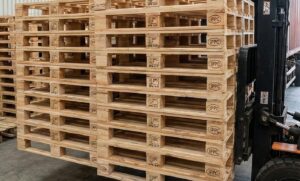
1. Euro Pallets (EPAL Style)
Specs: 1200mm x 800mm.
Best For: Exporting goods to the EU/UK.
Note: While official EPAL licensing is rare in smaller mills, top-tier exporters like Hawks Merchants produce “Euro-spec” pallets that match the dimensions and load capacity (1500kg+) perfectly for internal loop or one-way export use.
2. US Standard Stringer Pallets
Specs: 48” x 40” (GMA Standard).
Best For: The North American market.
Feature: 2-way or 4-way entry. Look for “notched stringers” to ensure forklift compatibility from all sides.
3. Industrial Skids & Custom Crates
Best For: Heavy machinery, marble, or textiles.
Trend: In 2026, there is a surge in demand for “Winged Pallets” (where the deck boards overhang the stringers) for shrink-wrapping stability in the textile export sector.
The Compliance Criticality: ISPM-15 Explained
You cannot import a single stick of raw wood packaging into the USA, EU, or Australia without ISPM-15 compliance. This is the International Standard for Phytosanitary Measures No. 15, designed to prevent the spread of pests like the pine wood nematode.
The “Heat Treatment” (HT) Stamp:
Every pallet from Pakistan must bear the IPPC stamp. This certifies the wood has been heat-treated to 56°C for at least 30 minutes.
⚠️ Buyer Warning: Some unethical traders may stamp pallets without proper treatment. Always ask for a Phytosanitary Certificate issued by the Department of Plant Protection (DPP) of Pakistan for every container. At Hawks Merchants, we provide digital tracking of our treatment cycles for full transparency.
5 Risks to Manage (and How to Solve Them)
1. The “Blue Stain” Fungus
Risk: Pallets loaded into a hot shipping container with >20% moisture content will arrive in Hamburg or New York covered in mold.
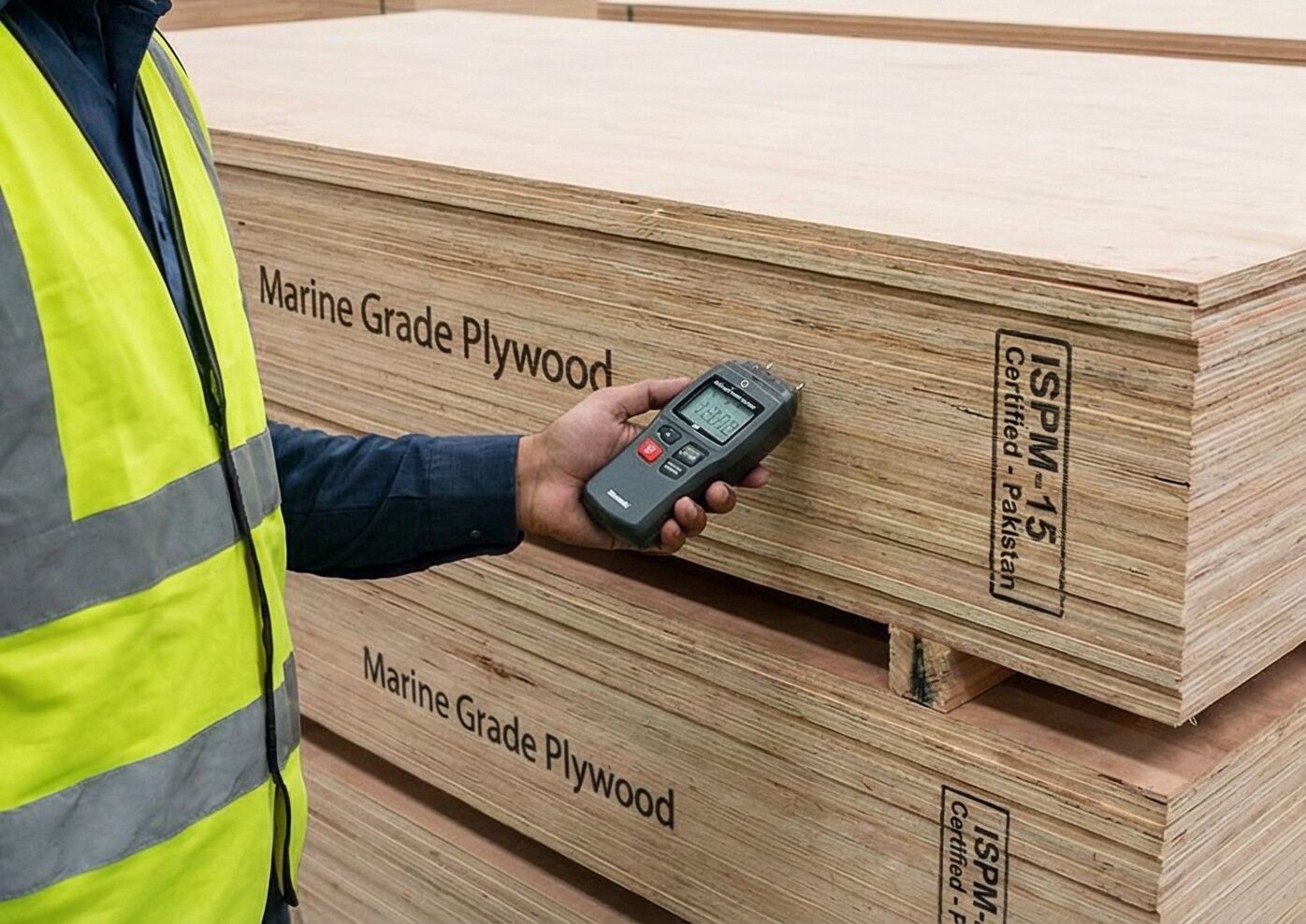
Solution: Specify “Kiln Dried (KD)” or “Air Dried” to under 18% moisture. Do not accept “Green Wood” (freshly cut) for long sea voyages.
2. Nail Pops
Risk: Manual hammering often leads to protruding nails that damage your product.
Solution: Partner with suppliers who use Pneumatic Coil Nailers and “Ring Shank” or “Screw Shank” nails, which have 2x the holding power of smooth nails.
3. Dimensional Drift
Risk: Variations in board thickness jam automated conveyors.
Solution: Require “Calibrated Lumber” where deck boards are planed to a uniform thickness before assembly.
4. Timber Legality
Risk: Importing wood from illegal logging can lead to fines under the US Lacey Act or EUDR.
Solution: Ensure your supplier sources from sustainable plantations (Poplar/Eucalyptus farms) rather than wild forest cutting.
5. Load Capacity Failure
Risk: A pallet collapses under weight.
Solution: Differentiate between Static Load (sitting on floor) and Dynamic Load (being moved by forklift). A pallet that holds 2000kg static might only hold 1000kg dynamic. Be specific.
How to Audit a Pakistani Pallet Supplier
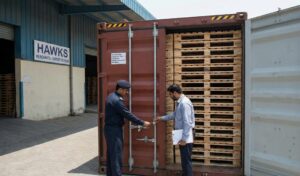
If you can’t visit in person, ask for a Video Audit. Here is what to look for:
Raw Material Stock: Do they have a large inventory of seasoning timber? (Shows financial stability).
The HT Chamber: Ask to see the Heat Treatment kiln in operation. Is it a professional setup or a makeshift room?
Assembly Line: Are they using jigs/templates? (Ensures consistency) or just eyeballing it?
Moisture Meters: Do they check every batch before loading?
Conclusion: The Supply Chain Advantage
In 2026, a pallet is not just wood it’s a data point in your logistics efficiency. Sourcing from Pakistan offers a unique opportunity to lower your packaging spend while maintaining the durability your supply chain demands. The key is moving away from “spot buying” and establishing a relationship with a manufacturer who understands export-grade requirements.
Hawks Merchants is that partner. We don’t just hammer wood together; we engineer logistics solutions. From ISPM-15 compliance to guaranteed moisture control, we ensure your goods travel safely, every time.
Secure Your 2026 Supply Chain
Need a quote for 40ft High-Cube container loads?